
As organizations become increasingly reliant on connected technologies, access control systems must remain secure and operational even when communications are disrupted.
Understanding how different access control architectures respond to connectivity issues is an important part of selecting the right solution. This article explores how Salto Space and Salto KS maintain continuity during communication interruptions and highlights the key differences between their approaches.
Modern access control systems need to do more than simply secure doors.
IT teams increasingly balance security requirements, operational continuity, remote management, and user experience when selecting access control technology. As environments become more connected, understanding how systems behave during communication disruptions becomes an important part of the evaluation process.
One question commonly asked is:
What happens if connectivity is interrupted?
The answer depends on the system architecture.
Different access control solutions are designed around different operational priorities. Understanding how systems behave during temporary communication disruptions helps organizations select the approach best aligned to their environment.
Understanding offline behavior
In Salto environments, "offline" refers to a situation in which communication between a lock and the IQ or Gateway is temporarily unavailable.
How a system behaves during this period depends on the architecture design and deployment configuration.
At Salto, offline behavior differs between Salto Space (SVN) and Salto KS because each solution is designed to support distinct operational requirements.
"Understanding how access control architectures respond to communication disruptions is key to selecting the right solution for your operational requirements." - Andrew Meier, Partner Training & Certification Manager at Salto Oceania
Salto Space smart access control in breakdowns and power outages
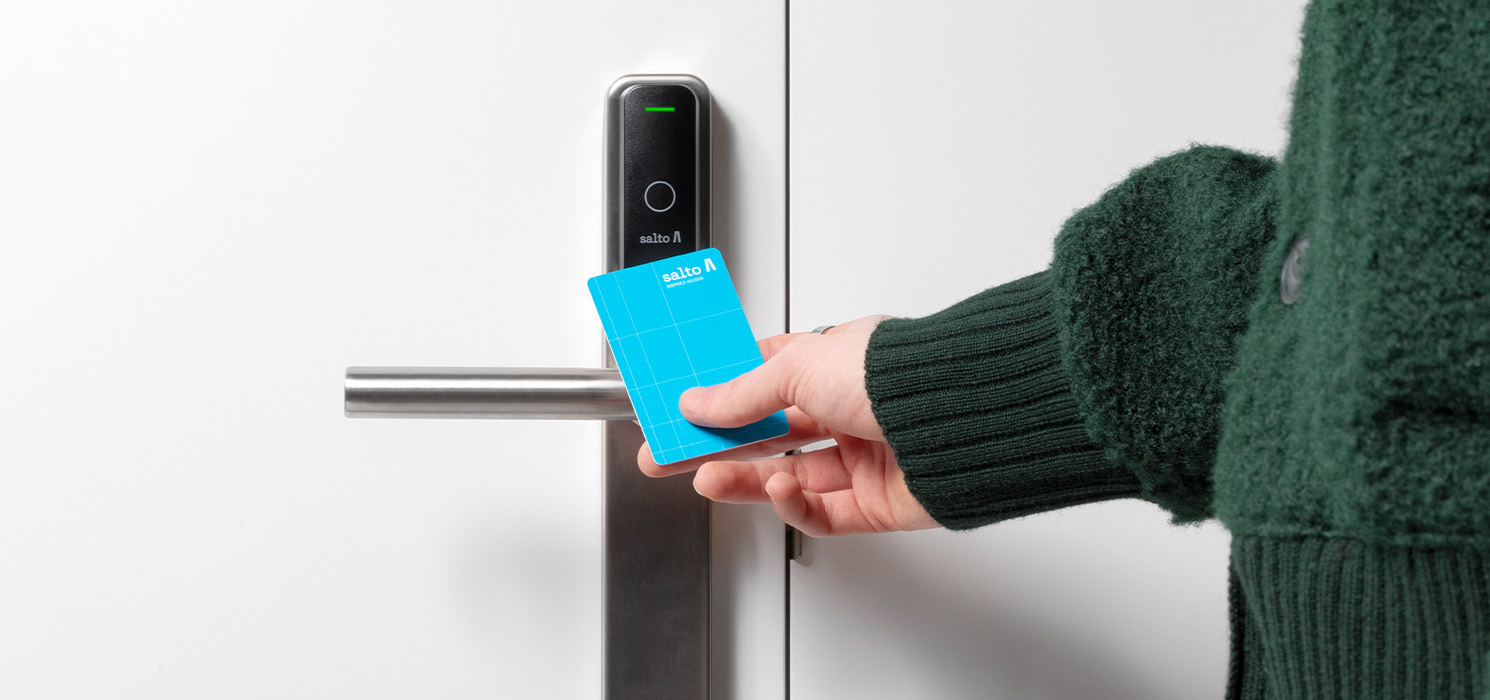
Salto Space uses Salto Virtual Network (SVN) technology built around a Data-on-Card and a smart, stand-alone, wire-free network. Within this architecture, smart stand-alone locks make access decisions locally without requiring continuous communication.
The Salto smart access control system from Space is designed to maintain secure, uninterrupted access even during power outages, thanks to its unique wire-free, networked architecture and the Salto Virtual Network (SVN) backbone. Unlike traditional access control systems that rely on continuous power and network connectivity, Salto uses smart standalone locks and encrypted data exchanges via user ID credentials.
This means access functionality works without needing to be connected and can continue operating independently during temporary communication disruptions, supporting environments where strong offline resilience and local decision-making are important operational requirements
When a user presents their credential to a door, the lock validates the access rights stored on the credential and writes updates back to it. This data-on-card system means no real-time network connection is necessary at the door locks, which can operate autonomously for months on battery power.
Key advantages of Salto Space in a power outage:
- No dependence on wired power at doors: Each lock is battery-powered.
- Network-independent functionality: Users carry encrypted access rights directly on their credentials (smartcards, fobs, or smartphones). Doors make instant, local validation decisions regardless of network or server connectivity
- Seamless data sync via SVN:Audit trails and updated access permissions continue to synchronize whenever users interact with wired or wireless SVN-Flex access points—ensuring data continuity without requiring continuous network uptime.
- The Salto Space decentralized infrastructure and resilient design ensure that access permissions, security logs, and door operations continue running smoothly, even in the event of a system-wide power failure.

For organizations prioritizing maximum resilience, this architecture offers a highly resilient approach while maintaining centralized access control. Salto Space combines wire-free, wireless electronic smart locks and wired online access points into a single, robust, cost-effective access control platform. By leveraging the Salto Virtual Network (SVN) data-on-card architecture, Salto Space extends advanced security to standard doors, non-door openings, and remote locations without requiring complex or expensive infrastructure.
Salto KS cloud-based access control in breakdowns and power outages
Salto’s cloud-based access control solution Salto KS combines the power of the cloud with the resilience of local storage, helping maintain continuity when connectivity is interrupted.
Salto KS supports continuity through three specific mechanisms. Locks configured for Offline Access retain a set of access permissions locally and can continue granting access if communication with the IQ is lost. The IQ stores credential data locally, allowing doors to continue operating if the connection between the IQ and the cloud is interrupted. Sites that require additional network resilience can also implement a cellular backup connection. Which of these capabilities applies depends on lock type, firmware version, and site configuration.
It's also important to understand how power outages affect the system. Salto KS wireless locks are battery-powered and are not affected by a building power outage. The IQ requires mains power and, without a UPS or alternative power source, will go offline during a power outage. In that situation, only locks configured for Offline Access can continue granting access using their locally stored permissions. By contrast, if the IQ remains powered but loses its connection to the cloud, doors continue operating using the encrypted credential data already stored on the IQ, although new access rule changes and real-time events will not be available until connectivity is restored.
This architecture enables organizations to combine cloud-based management with local continuity while supporting different levels of resilience depending on the site's configuration.
Comparing connectivity disruption behavior
While both Salto Space and Salto KS are designed to maintain operational continuity during communication disruptions, they do so through different architectural approaches.
Salto Space (SVN)
- Uses centralized administration combined with Salto's SVN Data-on-Card architecture.
- Access decisions are made locally at the lock without requiring continuous communication.
- Designed for maximum offline independence and resilience.
- Access permissions are distributed through credential updates using Data-on-Card technology.
- Particularly well-suited to environments where offline operation and business continuity are critical priorities.
Salto KS
- Uses cloud-based administration for remote management and visibility.
- Access decisions can continue locally when Offline Access has been configured on supported locks.
- Locks configured for Offline Access continue to grant access locally if the connection to the IQ is lost. If the connection between the IQ and the cloud is lost, doors continue to operate using the credential data already held on the IQ.
- Access permissions are managed through the cloud platform and, when offline access is enabled, can be validated locally by supported locks.
- Well-suited to organizations prioritizing remote administration, scalability, and multi-site management.
In summary, Salto Space prioritizes offline resilience through its Data-on-Card architecture and local decision-making. Salto KS prioritizes cloud-based management while supporting continuity through Offline Access, locally stored credential data on the IQ, and optional cellular backup connectivity where deployed.
For organizations prioritizing remote administration, scalability, and centralized visibility, Salto KS offers a flexible cloud-based solution. During communication disruptions, continuity can be maintained through features such as Offline Access and locally stored credential data, depending on site configuration and the credentials in use. PIN-based access is managed automatically through the IQ and does not require separate Offline Access configuration.
Designing for resilience
There is no single approach that suits every environment. Some organizations prioritize maximum offline resilience, while others place greater value on cloud-based administration and real-time visibility. Understanding how each architecture responds during communication disruptions helps ensure the selected solution aligns with operational requirements, security objectives, and long-term business needs.
To find the right architecture for your environment, contact us.